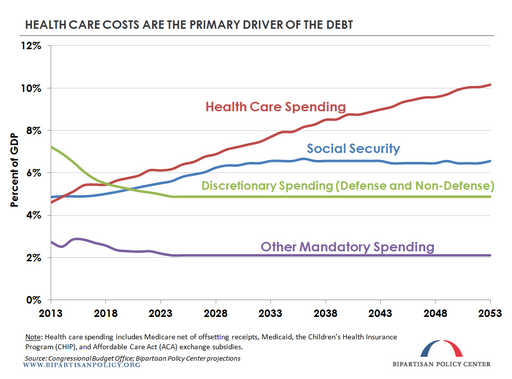
If you’ve been following the national economy, you know that, in fact, the Federal deficit has been going down. Recently President Obama has said that the cost of “health care is now the single-biggest factor driving down” the deficit. As an article by Lauren Carroll on PolitiFact points out, “the CBO [Congressional Budget Office} recently lowered its projection for long-term deficits and specifically cited health care costs as the main reason.” PolitiFact rates the President’s claim as “mostly true.” (A significantly higher rating than most of the campaign commercials we’re seeing these days!)
Although various employers realize varying degrees of benefit or disadvantage under the Affordable Care Act, clearly this is good news for the country as a whole and we applaud it. We would point out two very important considerations.
First, as the article points out, “even though projections are lower than they were years ago, health care spending is rising in the short term and will keep adding to the deficit.” That is not good news but it is to be expected. The ACA, afterall, primarily addressed insurance reform, not delivery reform. The cost controls it contains are, shall we say, not nearly as direct as they might have been. The insurance competition it promotes falls short of creating robust competition among providers - where 85% of the costs are realized.
Second, while unstated, we think it clear if we are to truly tame the beast of healthcare inflation, then employers must take the reins in pushing the kinds of market-based changes that will be needed The only way to do this is to purchase care on value rather than simply volume. Ensuring greater access to primary care - particularly for patients with chronic conditions - and then reallocating resources from low-value/high cost services to primary care is a great starting point. Using “value-based benefit design” to encourage the use of such services and, conversely, to discourage at least some of the 40% of services that are provided without benefit to patients (as documented in the Mayo Clinic Proceedings) is important. And directly engaging providers to avoid the unnecessary and inappropriate care identified by “Choosing Wisely” and Consumer Reports is another.
While the full impact of the complicated ACA cannot be known or appreciated at this point, we do believe it safe to say that the Federal government alone will not change the overall value proposition of healthcare. Colorado employers pay 60% of the tab. They should probably expect to have to do 60% of the work. We wish it were otherwise, but that would not be a wise business strategy. Though the Affordable Care Act is not necessarily the primary cause of that calculation, we rate Obama’s claim Mostly True.